Abdul El-Sayed wins Michigan Senate race, becoming the first Muslim elected to the US Senate
Democrat Abdul El-Sayed beat Trump-backed Mike Rogers by about 6 points in Michigan and will be the first Muslim ever to sit in the US Senate.
At a glance
- Democrat Abdul El-Sayed has won Michigan's open US Senate seat, defeating Republican former congressman Mike Rogers in the November 3 midterm election.
- He will be the first Muslim ever elected to the US Senate. The race was called at 2:27am Eastern time on Wednesday, with El-Sayed about 6 points ahead, roughly 52% to 46%.
- The contest was the most expensive election in Michigan's history, with more than $270 million in disclosed spending.
- El-Sayed, 41, a doctor and former Detroit health director who has never held elected office, ran on Medicare for All and getting money out of politics.
- Trump, Vice-President JD Vance and Rogers had all tried to link him to the Muslim Brotherhood; he told supporters: Michigan "chose hope".
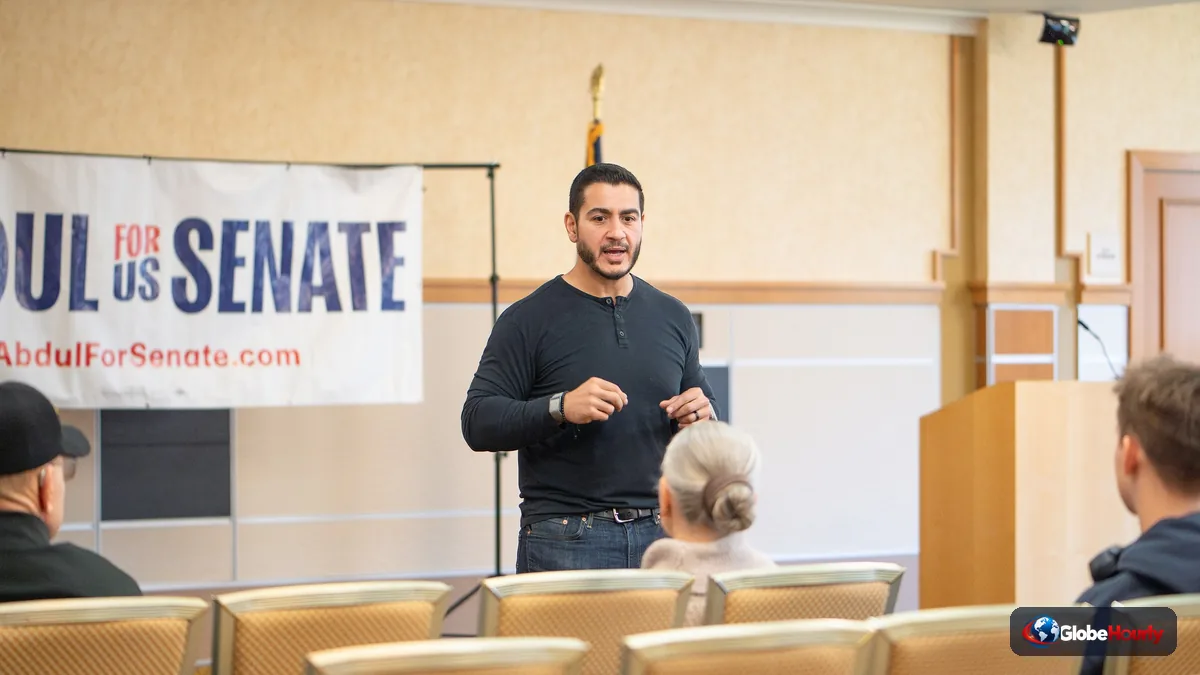
Abdul El-Sayed, a Democrat, has won Michigan's open seat in the US Senate, beating Republican Mike Rogers and becoming the first Muslim ever elected to the chamber. The race was called at 2:27am Eastern time on Wednesday, November 4, with El-Sayed ahead by about six percentage points, roughly 52% to 46%, with around 85% of ballots counted.
"Michigan, we did it," El-Sayed told supporters at the state Democratic Party's election-night event in Detroit, where he declared victory about an hour before the race was called.
The win came on a night when Democrats were projected to take control of both the House and the Senate. Michigan's seat was not needed for that majority, but it was one of the most closely watched contests in the country, and the most expensive in the state's history.
A 41-year-old doctor who has never held office
El-Sayed, 41, was born in Michigan to Egyptian immigrant parents. He trained as a physician and epidemiologist and ran Detroit's health department until 2017, when he resigned to run for governor. He lost that 2018 Democratic primary to Gretchen Whitmer by more than 20 points.
He has never held elected office. Since the governor's race he has co-written a book on Medicare for All, hosted a podcast and led public-health projects in Wayne County, the county that includes Detroit. One of them, a medical-debt programme, has cleared about $95 million of debt for more than 100,000 residents since 2024, well short of its $700 million goal; he changed early campaign messaging that had suggested the target was met.
The seat opened when Democratic Senator Gary Peters decided not to seek re-election. El-Sayed came through a contested Democratic primary in which Representative Haley Stevens was his main rival. Two days before the election, Stevens endorsed Rogers, a rare cross-party move.
How the vote broke
| Abdul El-Sayed (D) | Mike Rogers (R) | |
|---|---|---|
| Share of vote (early count) | about 52% | about 46% |
| Background | Physician, ex-Detroit health director | Former US congressman, ex-FBI agent |
| Main backers | Bernie Sanders, Alexandria Ocasio-Cortez, Barack Obama, Kamala Harris | Donald Trump |
| Prior statewide result | Lost 2018 governor primary | Lost 2024 Senate race to Elissa Slotkin |
Figures were still moving on Wednesday morning as the remaining ballots were counted, and the final margin may shift slightly.
Money, and the Muslim Brotherhood attacks
More than $270 million in disclosed spending poured into the race, beating the $217 million spent on the 2024 contest between Rogers and Slotkin. That total does not include undisclosed "dark money". El-Sayed and his allies were outspent by Rogers and outside groups by roughly three dollars to two.
The campaign's final weeks turned on religion. Trump, Vice-President JD Vance and Rogers each claimed that El-Sayed or members of his family had links to the Muslim Brotherhood. Many Democrats and local religious leaders, including non-Muslims, called the claims anti-Muslim. El-Sayed made it the centre of his victory speech, telling his opponents that they "chose hate, and Michigan chose hope".
He also framed the result as a test of money in politics, saying voters had built "something bigger than a bank account". A Michigan ballot measure to limit money in politics, Proposal 2, also passed on Tuesday.
What El-Sayed wants to do in Washington
His campaign slogan was "Money out of politics, money in your pocket, Medicare for All". His main promises:
- Health care: a single-payer Medicare for All system, the policy he has championed since 2018.
- Artificial intelligence: strict regulation of AI companies, and rules to make data centres meet utility and environmental standards. That puts him at the centre of a debate that moved markets on Wednesday, when Asian technology stocks fell on fears that a Democratic Congress would slow the AI data-centre build-out.
- Cost of living: cheaper prescriptions and medical-debt relief, building on his Wayne County programmes.
In a Democratic-controlled Senate, he is likely to join the progressive wing alongside Sanders.
Why the result matters beyond Michigan
Michigan has one of the largest Arab and Muslim American communities in the United States, centred on Dearborn and Hamtramck. In 2024, many Arab American voters there turned away from Democrats over the war in Gaza. El-Sayed's win suggests a large part of that vote has returned, and comes as Democrats also took the governor's office, where Jocelyn Benson beat Republican John James.
For Muslims in the US and in countries such as Pakistan, Egypt and Bangladesh, the result is a first. Muslims have served in the House of Representatives since 2007, when Keith Ellison of Minnesota took his seat, but none had won a Senate seat in the chamber's 237-year history.
When he takes his seat
El-Sayed will be sworn in when the new Congress meets on January 3, 2027, for a six-year term. Michigan's results will be certified by the state's board of canvassers later in November. Rogers had not publicly conceded by Wednesday morning.
Questions people are asking
Who is the first Muslim US senator?
Abdul El-Sayed, a Democrat from Michigan, became the first Muslim elected to the US Senate when he won the state's open seat on November 3, 2026. He takes office in January 2027.
Who won the Michigan Senate race in 2026?
Democrat Abdul El-Sayed beat Republican Mike Rogers by about six percentage points, roughly 52% to 46%, according to the count early on November 4.