Pakistan test-fires Fa'az, its first home-built air-to-air missile, from a JF-17 fighter
The Pakistan Air Force flight-tested Fa'az, its first locally developed beyond-visual-range air-to-air missile, from a JF-17. Range and speed were not disclosed.
At a glance
- The Pakistan Air Force has carried out the first flight test of Fa'az, the country's first locally developed air-to-air missile, the military's media wing ISPR said; footage was released on Tuesday, November 3.
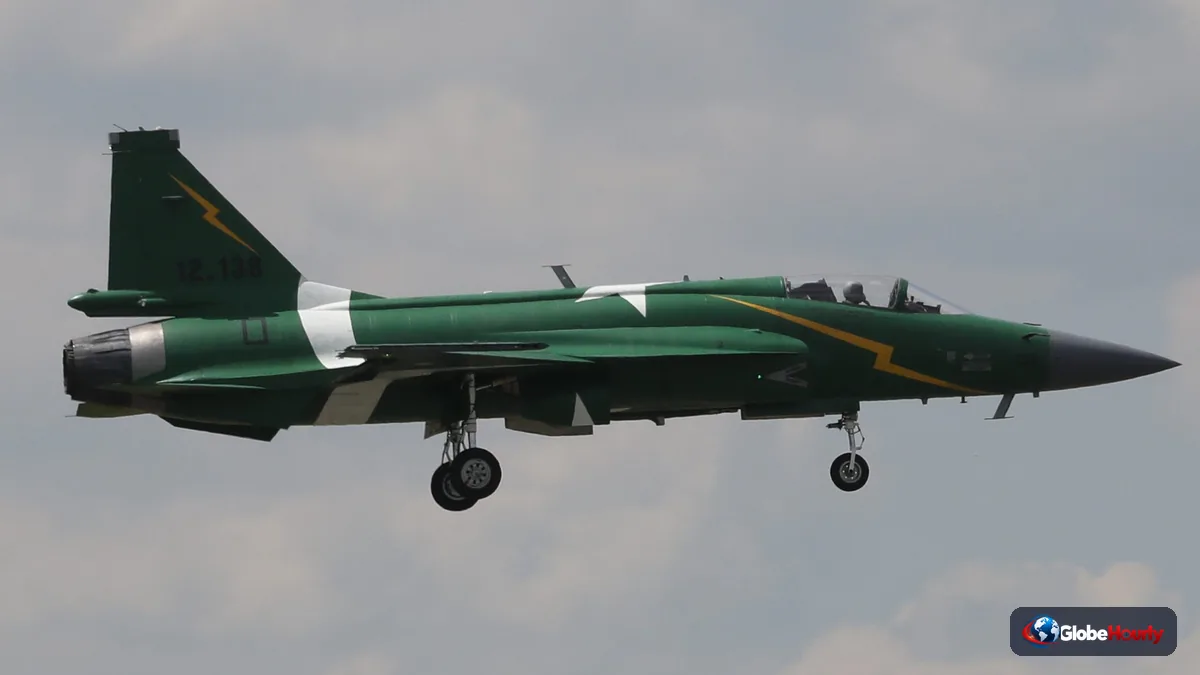
- The missile was fired from a JF-17 Block I fighter. ISPR said its terminal guidance system lets it hit enemy aircraft at longer ranges, but gave no range, speed or test location.
- Defence observers believe the tested version was Fa'az-IIR, with an imaging infrared seeker. Fa'az is built under the National Engineering and Scientific Commission (NESCOM).
- The PAF now relies on American and Chinese air-to-air missiles such as the AIM-120 AMRAAM and PL-15; this is Pakistan's third major missile test in less than a month.
Pakistan has flight-tested Fa'az, the first air-to-air missile it has designed and built itself, firing it from a JF-17 fighter jet. The military's media wing, Inter-Services Public Relations (ISPR), announced the test and released footage on Tuesday, November 3. It said the missile's terminal guidance system allows it to "engage enemy aerial targets at longer ranges".
Fa'az is a beyond-visual-range air-to-air missile, meaning a fighter can fire it at another aircraft that the pilot cannot see, often tens of kilometres away. Until now every missile of this kind in the Pakistan Air Force's (PAF) inventory has been bought from abroad.
What the footage shows, and what was left out
The video shows a JF-17 Block I taking off from an airbase that was not named, carrying the missile under its wing, and then firing it in flight. The JF-17 Thunder is built jointly by Pakistan Aeronautical Complex at Kamra and China's Chengdu Aircraft Corporation, and it is the backbone of the PAF's fighter fleet.
ISPR did not say how far Fa'az can fly, how fast it travels, where the test took place or when the missile will enter service. That is normal for a first test: the aim is usually to prove that the missile separates safely from the aircraft, that its motor and control fins work, and that it can be guided.
Defence observers believe the version tested was Fa'az-IIR, which uses an imaging infrared seeker. Such a seeker locks on to the heat picture of the target aircraft rather than bouncing radar waves off it, which makes it harder for the target to know it is being tracked. Fa'az has a modular design, which suggests other versions, possibly with a radar seeker, could follow. The programme comes under the National Engineering and Scientific Commission (NESCOM), the state body that also develops Pakistan's cruise and ballistic missiles.
Why a home-made missile matters to the PAF
| Missile | Origin | Type | Used by PAF on |
|---|---|---|---|
| AIM-120 AMRAAM | United States | Radar-guided, beyond visual range | F-16 |
| PL-15 | China | Radar-guided, long range | J-10C, JF-17 Block III |
| Other PL-series missiles | China | Short and medium range | JF-17 and other types |
| Fa'az | Pakistan | Beyond visual range (tested version believed infrared-guided) | JF-17 (first test) |
Air-to-air missiles decide modern air battles long before fighters get close to each other. Buying them abroad leaves an air force dependent on a foreign government's approval, on its prices and on its willingness to supply spare parts during a crisis. American missiles for Pakistan's F-16s have come with strict conditions on their use for decades.
The PAF now relies heavily on Chinese missiles, particularly the long-range PL-15, which drew worldwide attention after the India-Pakistan air clashes of May 2025. A missile Pakistan builds itself gives it a supply it controls, and an export product for the JF-17, which has already been sold to Myanmar, Nigeria and Azerbaijan.
Third major test in under a month
Fa'az is the latest in a run of missile tests. It is the third major one in less than a month, coming about a week after a test of an extended-range version of the Fatah-4 cruise missile. Pakistan has been expanding its local defence production since 2025, aiming to cut its import bill and its dependence on any single supplier.
The test also narrows a gap with India, which already flies its own home-built Astra beyond-visual-range missile on Su-30MKI and Tejas fighters. New Delhi rarely responds publicly to Pakistani missile tests.
What comes next
A new missile normally goes through several more firings, against towed or drone targets at increasing ranges, before it is cleared for squadron service. ISPR has not given a timeline. Further tests, and any decision on whether Fa'az will also be fitted to the newer JF-17 Block III and the J-10C, are the next things to watch.
Questions people are asking
What is the Fa'az missile?
Fa'az is Pakistan's first indigenously developed air-to-air missile, a beyond-visual-range weapon with a modular design built under NESCOM. It was first flight-tested from a JF-17 fighter in early November 2026.
What is the range of Pakistan's Fa'az missile?
Pakistan has not disclosed the range, speed or entry-into-service date. The military said only that its terminal guidance lets it engage aerial targets at longer ranges.