Dolores Huerta dies at 96: United Farm Workers co-founder
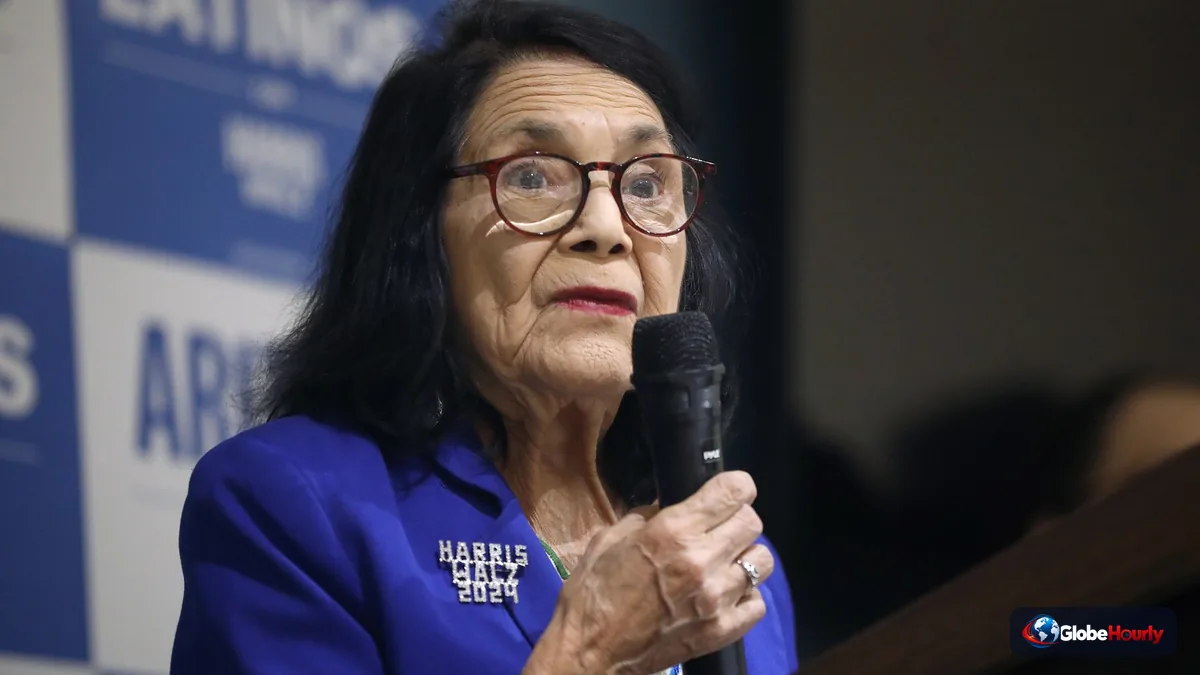
Dolores Huerta, the labour and civil rights leader who co-founded the farmworkers' union with César Chávez and coined 'Sí, se puede', has died of cancer at her home in Bakersfield, California, aged 96.
At a glance
- Dolores Huerta, co-founder of the union that became the United Farm Workers (UFW), died of cancer on Wednesday, October 28, 2026, at her home in Bakersfield, California, surrounded by family. She was 96.
- She co-founded the National Farm Workers Association with César Chávez and Gilbert Padilla in 1962, helped lead the Delano grape strike and national grape boycotts, and coined the slogan 'Sí, se puede'.
- She received the Presidential Medal of Freedom in 2012 and kept campaigning into her 90s through the Dolores Huerta Foundation, founded in 2002.
- California Governor Gavin Newsom ordered state flags lowered to half-staff; the UFW, NAACP and Los Angeles Mayor Karen Bass paid tribute.
Dolores Huerta, the American labour and civil rights leader who co-founded the farmworkers' union that became the United Farm Workers (UFW) and gave the movement its rallying cry "Sí, se puede", has died at the age of 96. She died of cancer on Wednesday, October 28, 2026, at her home in Bakersfield, California, surrounded by her family, family spokesperson Erik Olvera said.
Her life and work
Huerta was born Dolores Clara Fernández on April 10, 1930, in Dawson, New Mexico, the daughter of a farmworker and miner. After her parents divorced when she was three, her mother moved the family to Stockton, California, where she worked in a cannery and as a waitress before running a small hotel and restaurant.
Huerta trained as a teacher at Delta College and taught in rural California in the 1950s. Seeing farmworkers' children arrive at school hungry and without shoes, she left teaching to organise their parents.
| Year | Milestone |
|---|---|
| 1930 | Born in Dawson, New Mexico |
| 1955 | Co-founds the Stockton chapter of the Community Service Organization |
| 1960 | Founds the Agricultural Workers Association |
| 1962 | Co-founds the National Farm Workers Association with César Chávez and Gilbert Padilla |
| 1965 | Plays a leading role in the Delano grape strike |
| 1965–1999 | Vice president of the union that became the United Farm Workers |
| 1972 | Coins the slogan "Sí, se puede" |
| 1975 | Grape and lettuce boycotts help win California's Agricultural Labor Relations Act |
| 1998 | Eleanor Roosevelt Human Rights Award |
| 2002 | Founds the Dolores Huerta Foundation |
| 2012 | Presidential Medal of Freedom from President Barack Obama |
As the union's chief negotiator, Huerta won the first farmworker union contracts in US history. She pushed for safer working conditions, limits on harmful pesticides, and unemployment and health benefits for farm labourers, many of them Mexican and Filipino immigrants. She led the national table grape boycott, which brought millions of American shoppers into the farmworkers' cause.
In later decades she campaigned for women's rights, reproductive rights, LGBTQ+ rights and immigrants. She kept a busy schedule into her 90s, marching at protests and speaking across the country. In May 2026 she attended the unveiling of a mural in her honour in downtown Los Angeles.
A late revelation
In March 2026 Huerta said publicly for the first time that César Chávez had sexually abused her in the 1960s, saying she was pressured into sex and describing a second encounter as forced, and that both led to pregnancies she had kept secret for about 60 years. Chávez died in 1993. Her account prompted a re-examination of the movement's history.
Her life partner from the early 1970s was Richard Chávez, César's brother; they had four children. She had seven children from two earlier marriages.
Tributes
UFW President Teresa Romero said Huerta had left farmworkers and the entire Latino community stronger and more organised than she found them. NAACP President Derrick Johnson called her "a guiding light in the struggle for justice".
California Governor Gavin Newsom said she "represented the best of us" and ordered state flags flown at half-staff. Los Angeles Mayor Karen Bass called her death a great loss to the city and the country, and Los Angeles County also lowered its flags. The Congressional Hispanic Caucus described her as an icon whose courage helped change history.
Why she matters
Huerta helped turn some of America's lowest-paid and least protected workers into a political force. The farm labour laws, contracts and boycott tactics she helped create became a model for organising by immigrants and low-wage workers worldwide — relevant today in countries from the Gulf to South Asia, where migrant and agricultural workers still struggle for basic protections.
What happens next
Her family has asked for privacy and said it will announce plans to celebrate her life and legacy. Memorial events are expected in Bakersfield, where her foundation is based, and in Los Angeles.
Questions people are asking
How did Dolores Huerta die?
Dolores Huerta died of cancer on Wednesday, October 28, 2026, at her home in Bakersfield, California, surrounded by her family, a family spokesperson said. She was 96.
Who was Dolores Huerta?
Dolores Huerta was an American labour and civil rights leader who co-founded the National Farm Workers Association, later the United Farm Workers, with César Chávez in 1962. She led strikes and boycotts that won the first farmworker union contracts in US history and coined the rallying cry 'Sí, se puede'.
What does 'Sí, se puede' mean?
'Sí, se puede' is Spanish for 'Yes, it can be done' or 'Yes, we can'. Huerta coined it during a farmworkers' campaign in Arizona in 1972, and it became a slogan for labour, immigrant and civil rights movements.