Canada and EU launch 'alliance for the future' in Montreal, open eight months of talks on associate membership despite German objection
Carney and EU leaders set a June target for a new status for Canada, plus €500m for Ukraine and a digital deal. Germany rejects the 'associate' label.
At a glance
- Canada and the EU launched an 'alliance for the future' on Friday and agreed to eight months of talks on making Canada an associate member.
- German Chancellor Friedrich Merz rejects the term 'associate membership', and it does not currently exist in EU treaties.
- Canada will put an initial €500 million into an EU loan programme for Ukraine.
- The package includes a digital trade agreement, European Investment Bank funding for critical minerals projects in Canada, and a goal of Canada fully joining Erasmus+.
Canada and the European Union ended a two-day summit in Montreal on Friday by launching an "alliance for the future" and committing to eight months of negotiations on making Canada an associate member of the bloc. Prime Minister Mark Carney says he expects to conclude the talks by June. The catch is that the status does not exist yet, and Germany's chancellor does not want to use the name.
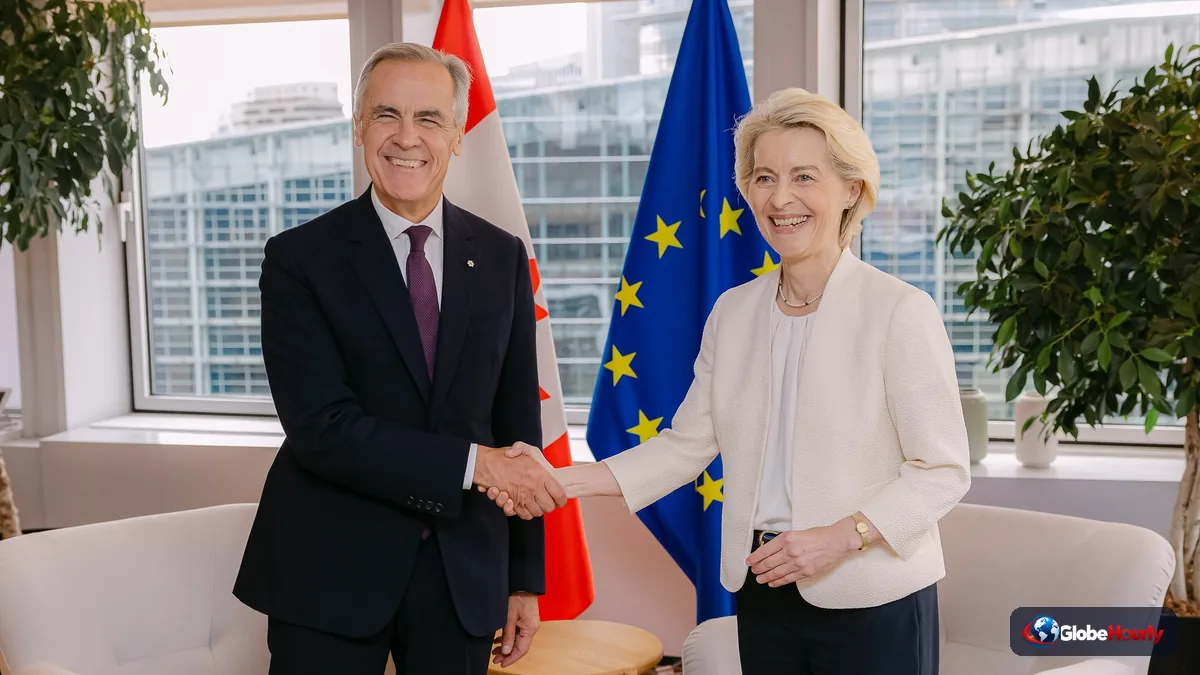
"Today we move toward associate membership for Canada and we launch a new alliance for the future," Carney told reporters, standing with European Commission President Ursula von der Leyen and European Council President António Costa.
What was signed, and what is only a promise
The two sides released a seven-page joint statement. Some of it takes effect through agreements signed in Montreal; other parts only commit officials to more work.
| Area | Outcome | Status |
|---|---|---|
| Associate membership | Eight months of negotiations | Talks only; term disputed |
| Digital trade | New agreement, including easier online payments | Announced |
| Critical minerals | European Investment Bank may fund projects in Canada | Announced |
| Ukraine | Canada joins EU loan programme with €500m (about C$775m) | Pledged |
| Artificial intelligence | Canadian researchers get access to European supercomputers | Announced |
| Energy | Feasibility study on LNG exports to Europe; nuclear agreement to be modernised | Under study |
| Students and youth | Goal of full Canadian entry to Erasmus+; youth mobility partnership to be explored | Goal |
| Carbon border tax, deforestation law | Discussed; Canada wants its carbon pricing recognised | Unresolved |
Carney argued that the deals would cut costs for small firms. A lobster harvester in Prince Edward Island would clear customs faster, he said, and a Vancouver tech startup would have "a smoother path to customers in Berlin".
Berlin's objection to two words
The argument over language is not cosmetic. Writing from a trip to Asia, Friedrich Merz welcomed "a new chapter" in relations but again declined to accept the term "associate membership". Von der Leyen, who proposed the idea in September, continues to use it and remains optimistic that Canada could become the first associate member. She describes it as association without accession, with closer coordination of policy and administration, and exchanges between parliaments and courts.
Asked about the disagreement on Friday, she did not address it directly. Costa offered his own description: the most unique relationship the bloc has.
Any new status would need the backing of every member state, and that is a high bar. Nine member states have still not ratified the existing Canada-EU trade deal, a point Canada's Conservatives raised on Friday. Critics on the European side also worry that Ottawa could use the talks mainly as leverage with Washington.
The Washington factor
Strained relations with the United States are driving much of this. Carney has pushed to reduce Canada's dependence on its southern neighbour after years of tariffs and President Donald Trump's talk of Canada as a 51st state, and Trump called the associate-member proposal hostile when it surfaced in September. Both sides also said they want to lessen reliance on China and the US for AI and critical raw materials.
What changes for ordinary Canadians and Europeans
Nothing changes at the border yet. No new right to live or work in the other jurisdiction has been created, and earlier reports of freer movement of workers applied only to strategic sectors such as energy, AI and defence. The nearest practical gains are for exporters using the digital trade rules and, if the Erasmus+ plan succeeds, for students who could study in Europe under the programme.
Carney has said any enhanced partnership would be debated in Canada's Parliament and put to a final vote.
The road to June
Carney is due to attend a meeting of von der Leyen's College of Commissioners next spring. Costa will then host him at a European Council meeting in June, which is the point at which leaders want the negotiations concluded.
Questions people are asking
Is Canada joining the European Union?
No. European Commission President Ursula von der Leyen described the idea as association without accession, so Canada would not become a member state. The status still has to be defined and negotiated.
What does associate membership of the EU mean?
The status does not exist yet and would have to be created. Proposals include closer policy coordination and freer movement of goods, services and workers in strategic sectors.