Russia-Africa summit opens in Moscow: Putin hosts 48 countries, 22 heads of state
Vladimir Putin opened the third Russia-Africa summit in Moscow on October 28 with delegations from 48 African countries, seeking more trade, security and nuclear deals as Russia's trade with Africa stays short of its target.
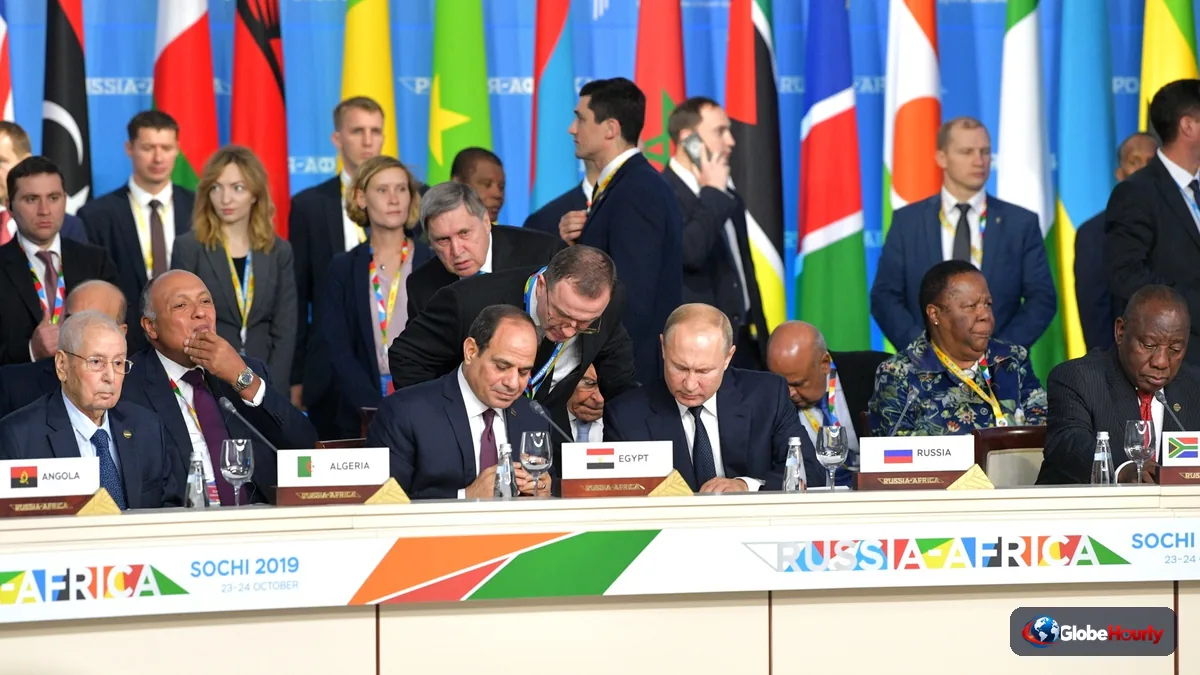
At a glance
- The third Russia-Africa summit opened in Moscow on Wednesday, October 28, 2026, and runs until Thursday, October 29.
- Delegations from 48 of Africa's 54 countries are taking part, 22 of them led by heads of state, according to Kremlin adviser Yury Ushakov — more than the 17 in 2023 but far fewer than the 43 at the first summit in 2019.
- Putin and Burundi's President Évariste Ndayishimiye, the current African Union chair, are co-chairing; 33 agreements and a 2027–2029 cooperation plan are due to be signed.
- Russia-Africa trade passed $27 billion in 2025, the Kremlin says — up from about $16.8 billion in 2019 but still well short of the $40 billion target Putin set seven years ago.
Russian President Vladimir Putin opened the third Russia-Africa summit in Moscow on Wednesday, October 28, 2026, welcoming delegations from 48 of Africa's 54 countries as he tries to widen Russia's economic, security and diplomatic footprint on the continent. The two-day meeting, co-chaired with Burundi's President Évariste Ndayishimiye as current chair of the African Union, is expected to end on Thursday with a political declaration, a cooperation plan for 2027–2029 and 33 signed agreements.
What is happening in Moscow
Kremlin foreign-policy adviser Yury Ushakov said 22 of the delegations are led by heads of state. Putin is holding a series of one-to-one meetings on Wednesday and will speak at the summit's plenary session on Thursday. An accompanying economic forum has more than 40 sessions on trade, food security, energy, mining, technology and transport.
| Summit | Year | City | Heads of state attending |
|---|---|---|---|
| First Russia-Africa summit | 2019 | Sochi | 43 |
| Second | 2023 | St Petersburg | 17 |
| Third | 2026 | Moscow | 22 |
Among the leaders expected are Egypt's President Abdel Fattah el-Sisi, who flew to Moscow on Wednesday and is due to address Thursday's plenary, Ethiopia's Prime Minister Abiy Ahmed, and the military leaders of Sahel states with close security ties to Moscow, including Mali's Assimi Goïta, Burkina Faso's Ibrahim Traoré and Niger's Abdourahamane Tchiani.
Opening the gathering, Putin described a shift towards a multipolar world and away from Western dominance as "both objective and irreversible". He said Russia plans to localise the production of Russian medicines and vaccines in Africa. The documents prepared for signing include a separate agreement on civilian uses of artificial intelligence.
The numbers behind the summit
| Indicator | Figure |
|---|---|
| Russia-Africa trade, 2019 | ~$16.8 billion |
| Russia-Africa trade, 2025 | >$27 billion |
| Putin's 2019 target | $40 billion |
| Russian farm exports to Africa, H1 2026 | $2.9 billion (+35%) |
| China-Africa trade, 2025 | ~$348 billion |
| EU-Africa trade, 2025 | ~$395 billion |
Russian agricultural exports to Africa, mostly wheat, rose 35% in value in the first half of 2026 to $2.9 billion, with record grain shipments. Moscow also wants more business in nuclear power, transport, farm machinery and manufacturing.
Background
Putin launched the summit series in Sochi in 2019, promising to double trade with Africa within five years. Since then Russia's role has grown fastest in security: after military takeovers in Mali, Burkina Faso and Niger, those governments expelled French forces and turned to Russian military contractors, first the Wagner group and now the defence ministry-controlled Africa Corps. Russia also uses Africa's votes at the United Nations to counter Western efforts to isolate it over the war in Ukraine.
The lower turnout of heads of state compared with 2019 reflects how cautious many African governments remain about being seen to take sides, especially those with strong trade links to Europe, the United States and China.
Reactions
The Kremlin presents the summit as a partnership of equals focused on development, food security and technology. Western governments and many analysts see it mainly as an effort by Moscow to expand its political influence and military presence and to show that it is not isolated. African leaders attending have generally framed their participation around trade, grain, fertiliser and energy needs.
Why it matters
For African countries that import Russian wheat and fertiliser, the summit can bring supply deals and lower-cost financing; for Russia it is a chance to show diplomatic reach at a time when its relations with Europe remain broken. For South Asia, the competition among Russia, China, the Gulf states and the West for African markets and minerals also shapes demand for exports such as Pakistani rice, textiles and pharmaceuticals and Indian goods and services in the same markets.
What happens next
Putin addresses the plenary session on Thursday, October 29, when the political declaration, the 2027–2029 action plan and the 33 agreements are expected to be signed. Details of individual deals — especially on nuclear energy and security — will become clearer as the bilateral meetings conclude.
Questions people are asking
When and where is the Russia-Africa summit 2026?
The third Russia-Africa summit is being held in Moscow on October 28–29, 2026. The first was in Sochi in 2019 and the second in St Petersburg in 2023.
How many African leaders attend the 2026 Russia-Africa summit?
The Kremlin says 48 of Africa's 54 countries sent delegations, with 22 represented by heads of state, including Egypt's Abdel Fattah el-Sisi and the leaders of several Sahel countries.
How much trade does Russia do with Africa?
According to the Kremlin, Russia-Africa trade exceeded $27 billion in 2025. That is far below Africa's trade with China (about $348 billion) or the European Union (about $395 billion).