UN votes 130-17 against US embargo on Cuba, weakest support in decades; US expels Cuban diplomat
The UN General Assembly again called for an end to the US embargo on Cuba, but backing fell to 130 votes from 165 after a US lobbying drive — and Washington expelled a Cuban diplomat over a scuffle during the debate.
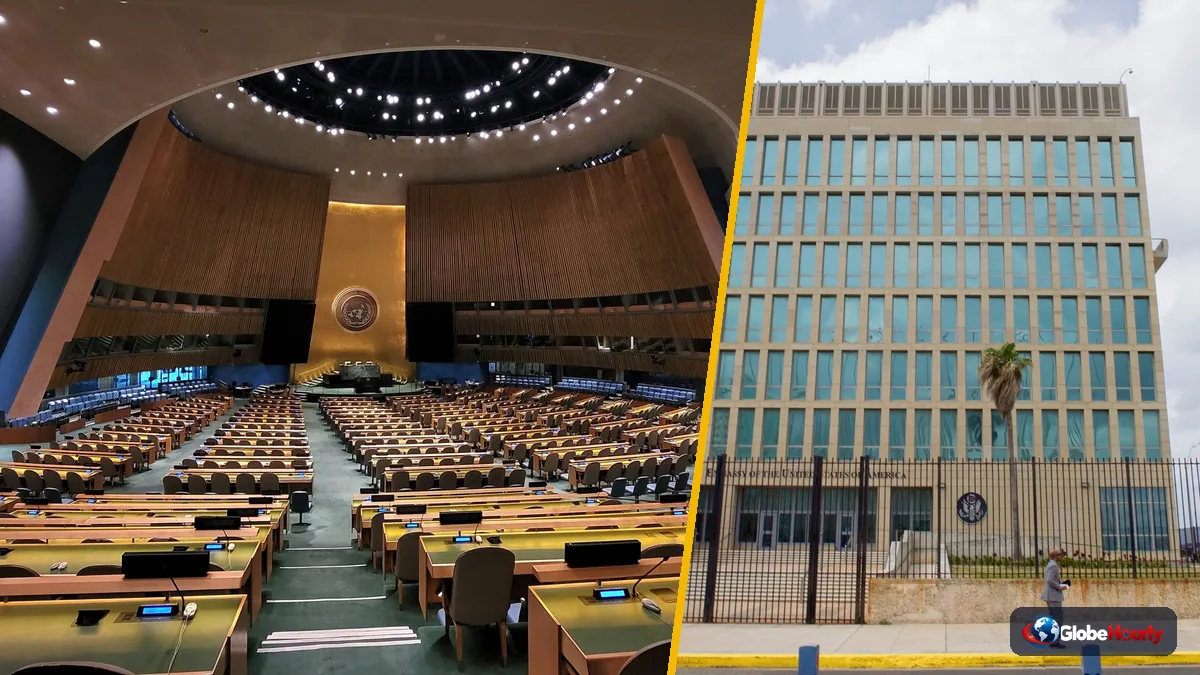
At a glance
- The UN General Assembly adopted Cuba's annual resolution against the US embargo on Wednesday, October 28, 2026, by 130 votes to 17, with 25 abstentions; 21 countries did not vote.
- That is down from 165-7-12 in 2025 and is the weakest support for the resolution in decades, after a US campaign urging governments to vote no or abstain.
- New no votes included Colombia, Ecuador, Costa Rica, Morocco, the UAE, the Czech Republic, Lithuania and Slovenia; Germany abstained for the first time since 2002.
- The United States expelled Richard Tur de la Concepción, first secretary of Cuba's UN mission, accusing him of shoving a US aide during the debate; the State Department said he has left the country.
- Cuba called the US account false, accused the US aide of harassing its diplomat and complained to UN Secretary-General António Guterres.
The UN General Assembly on Wednesday, October 28, 2026, again called on the United States to end its decades-old economic embargo on Cuba, but support fell sharply to 130 votes in favour, 17 against and 25 abstentions — the weakest backing for the annual resolution in decades. The vote followed a heated two-day debate in New York, during which the United States accused a Cuban diplomat of shoving an American aide and then expelled him from the country.
The vote
The resolution, which Cuba has brought to the General Assembly every year since 1992, passed for the 34th consecutive year. But the margin shrank dramatically: in 2025 it was adopted by 165 votes to 7, and in 2024 by 187 to 2. A further 21 member states did not take part in Wednesday's vote. UN figures describe it as the lowest support in two decades; by some counts it is the weakest since 1995.
| Year | In favour | Against | Abstentions |
|---|---|---|---|
| 2024 | 187 | 2 | 1 |
| 2025 | 165 | 7 | 12 |
| 2026 | 130 | 17 | 25 |
The 17 countries that voted against were the United States, Israel, Argentina, Bosnia and Herzegovina, Colombia, Costa Rica, the Czech Republic, Ecuador, Hungary, Lithuania, Morocco, North Macedonia, Paraguay, Slovenia, Trinidad and Tobago, Ukraine and the United Arab Emirates. Colombia, which supported the resolution last year, switched to a no vote. Among the abstentions, Germany broke a voting record it had kept since 2002, and Chile, Peru, Honduras and the Dominican Republic also abstained.
The clash and the expulsion
The debate turned confrontational on Tuesday, October 27, when US Ambassador Mike Waltz accused Cuba's leadership of corruption and forced labour, showing photos of Fidel Castro and President Miguel Díaz-Canel wearing luxury watches. Cuban delegates banged their desks and demanded a point of order, and Foreign Minister Bruno Rodríguez Parrilla walked towards the podium accusing Waltz of lying.
Waltz later said Richard Tur de la Concepción, first secretary of Cuba's UN mission, had shoved a US diplomat and tried to grab the phone of his spokesman, J.P. Freire, who was filming the protest. In a television interview on Tuesday night, Waltz said Secretary of State Marco Rubio had signed the expulsion order and that the diplomat would be on a plane to Havana within 24 hours. "You lay a hand on an American here in the United States," he said, adding that Washington would not tolerate it. The State Department later said the diplomat had left.
Cuba's response
Havana rejected the US account. Rodríguez Parrilla called Waltz's speech a "media circus" and posted his own video of the incident. In a letter to the UN, Cuban Ambassador Ernesto Soberón accused Freire of harassing Tur and continuing to film him despite objections, and asked the UN's security and legal offices to intervene. Cuba also complained to Secretary-General António Guterres. Before the vote, Cuban officials accused the US of intense diplomatic pressure on other governments to drop their support for the resolution.
Background
The US embargo was first imposed in the early 1960s after Fidel Castro's revolution and later written into US law, including the 1996 Helms-Burton Act, so only Congress can fully lift it. The Trump administration has tightened sanctions on Cuba, which is going through its worst economic crisis in decades, with long power cuts, shortages of food and fuel, and large-scale emigration. Cuba says the embargo has cost its economy well over $100 billion; Washington says the island's problems come from its own government's policies.
Why it matters
General Assembly resolutions are not binding, so the vote does not change US policy. But for three decades the near-unanimous result was one of Cuba's strongest diplomatic symbols. A drop of 35 supporters in one year — including several Latin American governments that changed position — shows how successfully Washington has pressed allies, and how isolated Havana has become, even as most of the world still opposes the embargo. The expulsion adds to tension between the two countries at a time of tighter US sanctions.
What happens next
The resolution will return to the Assembly next year. Cuba has nominated Tur for a seat on a UN budget committee, and that candidacy had not been withdrawn as of Wednesday. Further responses from Havana, including any reciprocal measures against US diplomats in Cuba, are being watched.
Questions people are asking
What was the result of the 2026 UN vote on the Cuba embargo?
On October 28, 2026, the UN General Assembly passed the resolution calling for an end to the US embargo on Cuba by 130 votes in favour, 17 against and 25 abstentions. It was the 34th year in a row the resolution passed, but with far less support than in 2025, when 165 countries backed it.
Why did the US expel a Cuban diplomat in October 2026?
US Ambassador Mike Waltz said Cuban diplomat Richard Tur de la Concepción shoved and tried to grab the phone of a US aide who was filming Cuban delegates protesting during Waltz's speech at the UN on October 27. Secretary of State Marco Rubio signed the expulsion order, and the diplomat has left the United States; Cuba disputes the US version.
Is the UN resolution against the Cuba embargo binding?
No. General Assembly resolutions are not legally binding, so the vote does not lift the embargo; only the US Congress and government can change the sanctions, most of which are written into US law.