Belgrade Israeli embassy attack: knife attacker shot dead, Serbia raises terror alert to red
A teenager armed with two knives attacked a police guard outside Israel's embassy in Belgrade just after midnight on Wednesday and was shot dead; Serbia has raised its terrorism threat level to the highest.
At a glance
- Just after midnight on Wednesday, October 28, 2026, an attacker with two knives attacked a gendarmerie officer guarding the Israeli embassy in Belgrade.
- The officer, who suffered a minor knife wound to the face, shot the attacker dead; prosecutors and police said he acted in self-defence.
- Outgoing Interior Minister Ivica Dačić said the attacker was a minor known to security services as a supporter of the Islamic State group, and called it a terrorist attack.
- Serbia raised its terrorism threat level to red, the highest, with more police at embassies, infrastructure and crowded places.
- It is the second attack on a guard at the same embassy since June 2024; no embassy staff were hurt.
A teenager armed with two knives attacked a police officer guarding Israel's embassy in Belgrade shortly after midnight on Wednesday, October 28, 2026, and was shot dead by the officer, Serbian authorities said. Outgoing Interior Minister Ivica Dačić called it a terrorist attack by a known supporter of the Islamic State group, and Serbia raised its national terrorism threat level to red, the highest.
What happened
According to the interior ministry, the attacker approached the guard post outside the Israeli embassy in the Serbian capital just after midnight and attacked a member of the gendarmerie with two knives. The officer suffered a minor knife wound to the face — prosecutors said he was hit in the cheek by a thrown knife — and fired at the attacker, killing him at the scene.
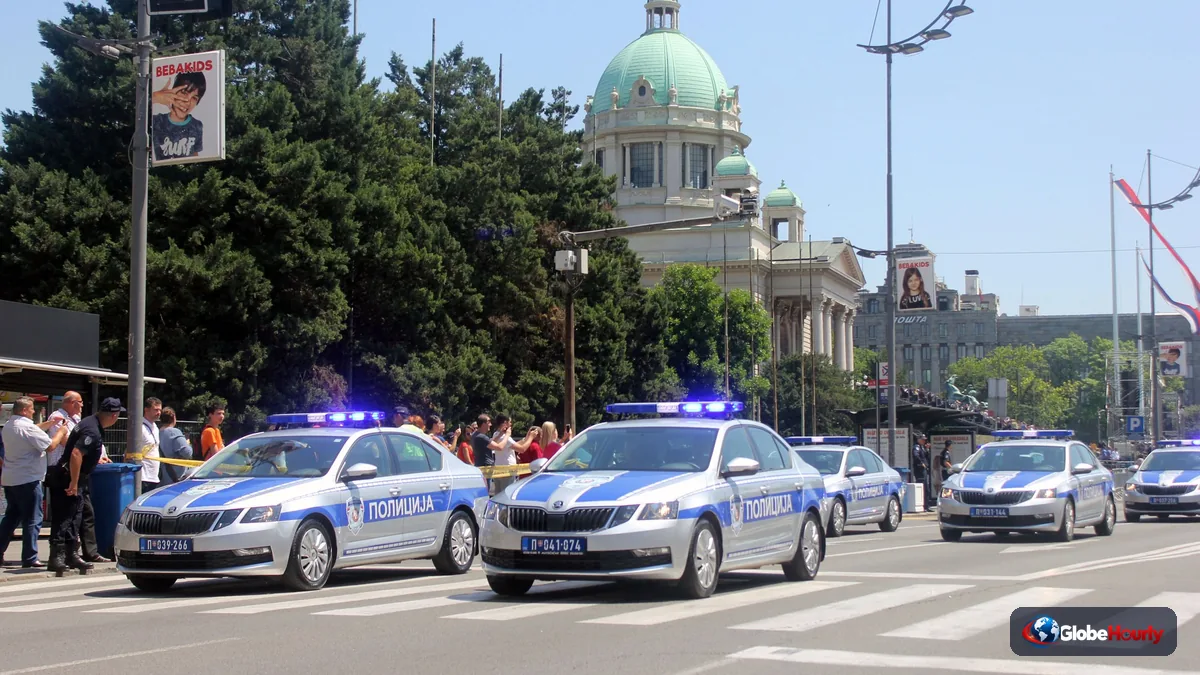
Dačić said the attacker shouted "Allahu Akbar" during the assault. Police photos later showed the guard's booth outside the embassy sealed off with tape, with heavily equipped officers nearby. The prosecutor's office said the officer's use of his weapon was justified self-defence.
| Detail | Information |
|---|---|
| Date and time | Wednesday, October 28, 2026, shortly after midnight (about 4 a.m. PKT) |
| Place | Guard post outside the Israeli embassy, Belgrade, Serbia |
| Weapons | Two knives |
| Attacker | A minor, not yet formally identified; believed to be from Šabac |
| Attacker's fate | Shot dead by the guard |
| Officer | Gendarmerie member, minor knife wound to the face |
| Embassy staff | None hurt, according to Israel's foreign ministry |
| Threat level | Raised to red (highest) nationwide |
Who was the attacker
Dačić described the attacker as "a minor, so far unidentified". Some accounts said he was 16 years old and appeared to have acted alone. The minister said Serbia's security services had been monitoring him as a supporter of the Islamic State group, and that his Instagram profile displayed the group's black flag and emblem. Officials believe he came from Šabac, a city in western Serbia. Investigators are examining how he reached the embassy and whether anyone else was involved.
Background
Attacks of this kind are rare in Serbia, but the same embassy was targeted in June 2024, when a man fired a crossbow bolt at a guard, seriously wounding him in the neck, before being shot dead. That attacker, a 25-year-old from near Belgrade, was also described by officials as holding extremist Islamist views.
The new attack comes at a sensitive political moment. Serbia held an early parliamentary election on Sunday, in which Aleksandar Vučić's camp was defeated by a youth-led movement that grew out of almost two years of protests. A new government has not yet been formed, so the outgoing ministers, including Dačić, remain in charge of the police. Israel, meanwhile, held its own parliamentary election on Tuesday, which exit polls suggested produced no clear winner.
Reactions
Dačić said the incident was being treated as a terrorist attack and announced an increased police presence at key locations across the country. Israel's foreign ministry described the incident as an attempted terrorist attack near its embassy in Belgrade and said none of its staff were hurt.
Why it matters
The red alert means tighter security checks and more police around embassies, government buildings, transport hubs, infrastructure and crowded places such as shopping centres and stadiums for the coming days. Across Europe, security services have warned that young people radicalised online are a growing share of terrorism suspects; this case — a minor already known to the authorities — is likely to add to that debate. Jewish and Israeli sites in several countries have been under heightened protection since the Gaza war.
What happens next
Prosecutors are expected to formally identify the attacker and set out how he was radicalised and whether he had help. The threat level stays at red until the authorities decide to lower it. Serbia's incoming government, once formed, will inherit the investigation and the wider question of how the security services monitor known extremists.
Questions people are asking
What happened at the Israeli embassy in Belgrade?
Shortly after midnight on October 28, 2026, an attacker armed with two knives attacked a police officer guarding the Israeli embassy in Belgrade. The officer was lightly wounded in the face and shot the attacker dead.
Who was the Belgrade embassy attacker?
Serbia's interior minister said the attacker was a minor whose identity had not yet been formally established, and that security services had been monitoring him as a supporter of the Islamic State group. Officials believe he came from Šabac in western Serbia.
What is Serbia's terror threat level now?
Serbia raised its terrorism threat level to red, the highest level, after the attack. This means more police at sensitive sites such as embassies, infrastructure and crowded places, and tighter security checks.