Serbia election: students flood Belgrade before Sunday's snap vote against Vučić
Thousands of students marched into Belgrade for a final rally before Serbia's October 25 snap election, where a student list is challenging Aleksandar Vučić's ruling party in a tight race.
At a glance
- Students who marched on foot from cities across Serbia poured into Belgrade on Wednesday evening and held a final rally on Thursday, October 22, before Sunday's snap parliamentary election.
- The vote on October 25 pits a student-backed electoral list against the United Serbia coalition led by Aleksandar Vučić's Serbian Progressive Party (SNS).
- Vučić, who called the early election in September, stepped down as president to run for prime minister; he called the race 'tight' on Thursday.
- Polls are split: one survey released this week shows a statistical tie, while a late-September poll gave Vučić's alliance a lead of more than 10 points.
- The protest movement began after a station canopy collapse in Novi Sad killed 16 people in November 2024.
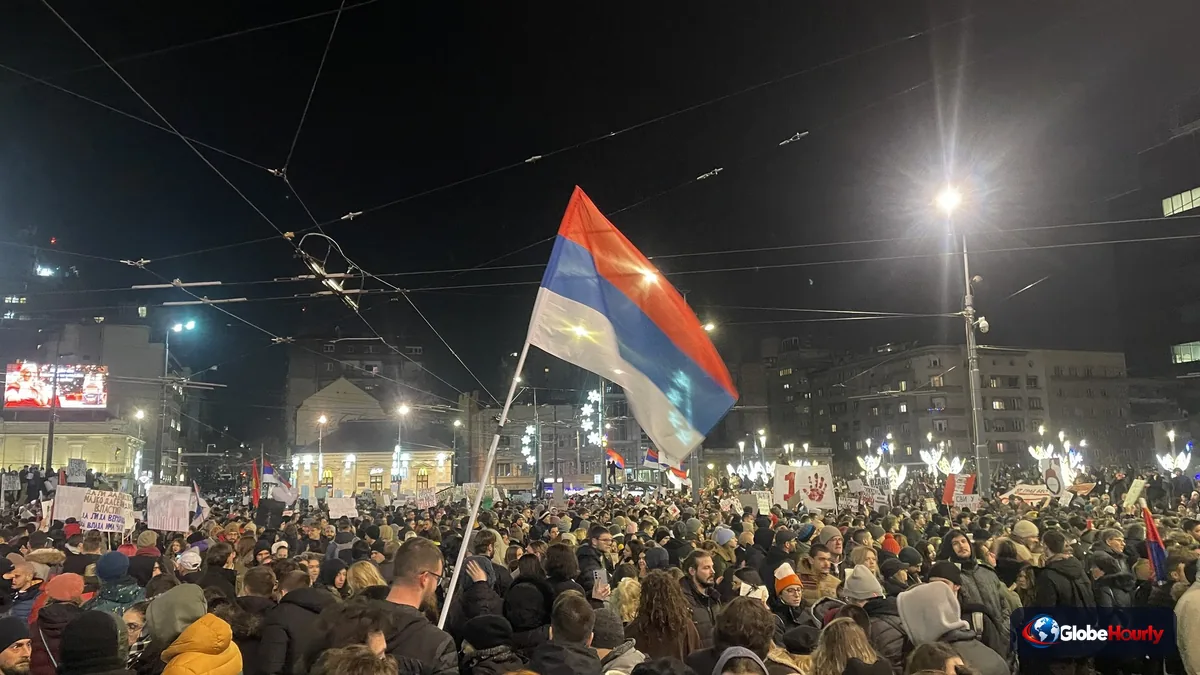
Thousands of students who walked to Belgrade from towns and cities across Serbia filled the capital on Wednesday evening and held their final campaign rally on Thursday, October 22, three days before a snap parliamentary election. The vote on Sunday, October 25, is the biggest electoral test in years for Aleksandar Vučić, who has dominated Serbian politics for 14 years and is now running for prime minister against a list backed by the student protest movement.
What happened
More than 1,000 students set off on foot several days ago from different cities, and residents greeted them along the way. As they reached Belgrade on Wednesday night, crowds lit flares and fireworks to welcome them. Thursday evening's gathering in central Belgrade was the last big event of the student campaign before the pre-election silence.
| Item | Detail |
|---|---|
| Election | Snap parliamentary election, 250 seats |
| Date | Sunday, October 25, 2026 |
| Originally due | December 2027 |
| Main contenders | United Serbia (Vučić's SNS-led coalition) vs the Student List |
| Threshold | 3% of the vote |
| Latest NSPM poll (released Oct 20) | Statistical tie between the two |
| Faktor Plus poll (late September) | United Serbia ahead by more than 10 points |
Vučić called the early election in September and later resigned the presidency so he could lead his party's list and run for prime minister, a move that would extend his time in power. In a radio interview broadcast on Thursday, he described the race as "tight" and the campaign as "very difficult". He repeated his claim that large sums of money from abroad have entered the country to "overthrow the state" — an accusation the students reject.
Background
The movement began on November 1, 2024, when the concrete canopy of the newly renovated railway station in Novi Sad collapsed, killing 16 people. Students blamed corruption and weak oversight of state building contracts, and began blockading universities. The protests grew into the largest in Serbia in decades, with road blockades, strikes and mass rallies in Belgrade, Novi Sad, Niš and Kragujevac.
The pressure forced Prime Minister Miloš Vučević, a former mayor of Novi Sad, to resign in early 2025. For almost two years the students refused to align with any party. This year they decided to run their own list, and some opposition parties have since joined it. Support for the traditional opposition has fallen from about 30% to between 10% and 15%, and some parties risk falling below the 3% threshold.
Reactions
Student organisers say the vote is a chance to turn street protests into change through the ballot box, while admitting the struggle will be difficult. The Democratic Party, one of the older opposition groups, has denied having "any kind of influence" over the students, after government figures accused opposition parties of controlling the movement.
Vučić says the outcome is open. Analysts note that his party still controls most national media and has a strong network in rural areas, while the students' strength lies in cities and among young voters.
Why it matters
Serbia is a candidate for EU membership but has kept close ties with Russia and China, and Vučić has refused to join EU sanctions on Moscow. A strong showing by the student list could change the direction of a country that sits at the centre of the Western Balkans and borders four EU members. A narrow Vučić win could bring further protests if the opposition disputes the count. Investors are also watching: Serbia is a growing hub for car-making, mining and Chinese-funded infrastructure.
What happens next
Campaigning now gives way to the legally required pre-election silence, and polls open on Sunday morning, October 25. The electoral commission is expected to publish preliminary results from late on Sunday night, and international election observers will report on how the vote was run. If no list wins a majority of the 250 seats, coalition talks will follow, and parliament must elect a government within 90 days of its first sitting.
Questions people are asking
When is the Serbian election 2026?
Serbia holds a snap parliamentary election on Sunday, October 25, 2026. The vote was called in September, more than a year before it was due in December 2027.
Who is running in the Serbian election?
The main contest is between Aleksandar Vučić's United Serbia coalition, led by his Serbian Progressive Party, and a list backed by the student protest movement. Traditional opposition parties are also running, though some have joined the student list.
Why are students protesting in Serbia?
The protests began after the concrete canopy of Novi Sad railway station collapsed in November 2024, killing 16 people. Students blame corruption and poor oversight and have demanded accountability, which grew into a wider movement against Vučić's government.